Westbrook Lane Primary School
nurtures confident children with caring hearts and curious minds
History Curriculum
Intention
A well planned and effectively implemented curriculum begins with a sound and secure knowledge of the National Curriculum purpose and aims for the subject.
National Curriculum Purpose for History
A high-quality history education will help pupils gain a coherent knowledge and understanding of Britain’s past and that of the wider world. It should inspire pupils’ curiosity to know more about the past. Teaching should equip pupils to ask perceptive questions, think critically, weigh evidence, sift arguments, and develop perspective and judgement. History helps pupils to understand the complexity of people’s lives, the process of change, the diversity of societies and relationships between different groups, as well as their own identity and the challenges of their time.
National Curriculum Aims
Ensure that all children:
-
know and understand the history of these islands as a coherent, chronological narrative, from the earliest times to the present day: how people’s lives have shaped this nation and how Britain has influenced and been influenced by the wider world
-
know and understand significant aspects of the history of the wider world: the nature of ancient civilisations; the expansion and dissolution of empires; characteristic features of past non-European societies; achievements and follies of mankind
-
gain and deploy a historically grounded understanding of abstract terms such as ‘empire’, ‘civilisation’, ‘parliament’ and ‘peasantry’
-
understand historical concepts such as continuity and change, cause and consequence, similarity, difference and significance, and use them to make connections, draw contrasts, analyse trends, frame historically-valid questions and create their own structured accounts, including written narratives and analyses
-
understand the methods of historical enquiry, including how evidence is used rigorously to make historical claims, and discern how and why contrasting arguments and interpretations of the past have been constructed
-
gain historical perspective by placing their growing knowledge into different contexts, understanding the connections between local, regional, national and international history; between cultural, economic, military, political, religious and social history; and between short- and long-term timescales
History at Westbrook
At Westbrook, our curriculum follows the statutory guidance and is designed to link with other subjects taught across the curriculum as well as provide the full National Curriculum entitlement to children.
Our history curriculum is designed to nurture confident individuals with caring hearts and curious minds by inspiring children to explore the past, understand the present and shape the future. A feature of our curriculum design is the use of the Curriculum Companion (Chris Quigley Education) and Keystage History to support teachers with research based, high quality lesson planning and formative assessment tasks.
Through engaging with local history, pupils develop a deep sense of identity and belonging, discovering how their community has evolved and contributed to wider historical events in the UK and beyond.
We support our children to become thoughtful historians who ask meaningful questions, evaluate evidence critically, and appreciate diverse perspectives. By connecting historical learning to the challenges and opportunities of the future world, we encourage pupils to reflect on how past decisions, innovations and events influence the society they live in today—and the one they will help build tomorrow.
Our intent is to cultivate historical curiosity and empathy, enabling children to understand change, continuity, and the complexity of human experiences. In doing so, we develop them as informed, responsible citizens who value their heritage and are equipped to contribute positively to their local communities and beyond.
Implementation
Quality first curriculum implementation in history supports children in becoming secure, and fluent in the identified agreed core knowledge and skills in history. At Westbrook, the journey to becoming passionate towards history begins in the Early Years. Our youngest children learn about history within the EYFS area of learning known as Understanding the World. These will be led by the children’s interest and the ‘here and how’ gained from the observation, assessment and planning cycle. An example of how we inspire a love for history in EYFS includes the children learning about their own personal milestones and what life was like for grandparents. They are introduced to a range of artefacts and sources (photographs, films) which support the development of history vocabulary and questions.
By the time children reach the end of Year Six, they will be secure in their historical knowledge and will be working in line with age related national expectations. They will also have a rich and deep knowledge of local, national and international history and historically significant people. Furthermore, they will be able to use their historical thinking skills such as exploring, considering, reflecting and evaluating to have a positive impact on their own future learning.
Higher attainers in history are challenged to ensure they become fluent with the core key concepts through additional questioning and prompts (and tasks where appropriate) which helps extend their verbal reasoning skills as well as supporting them to engage in creating, evaluating, and analysing, delving deeper into the subject content.
Impact
Monitoring & Assessing Progress in history
Assessing children’s progress is vital in order to establish their acquisition of knowledge and skills and building confidence and fluency in all subjects. At Westbrook learning always starts with the children’s prior knowledge and any misconceptions they may have. Class teachers decide upon the most appropriate age-related way of obtaining the children’s prior knowledge. Misconceptions that arise throughout the unit are identified and addressed appropriately by the teacher.
Teachers track progress through teacher judgement, supplemented by frequent low stakes knowledge recalls (frequently in quiz format), the use of children’s written work to see if they have used the words for formal elements of history correctly focussing on key vocabulary from their unit of study. Teachers also use formative assessment of pupils’ knowledge when re-showing images of history previously studied in the curriculum, to check whether pupils remember previous learning.
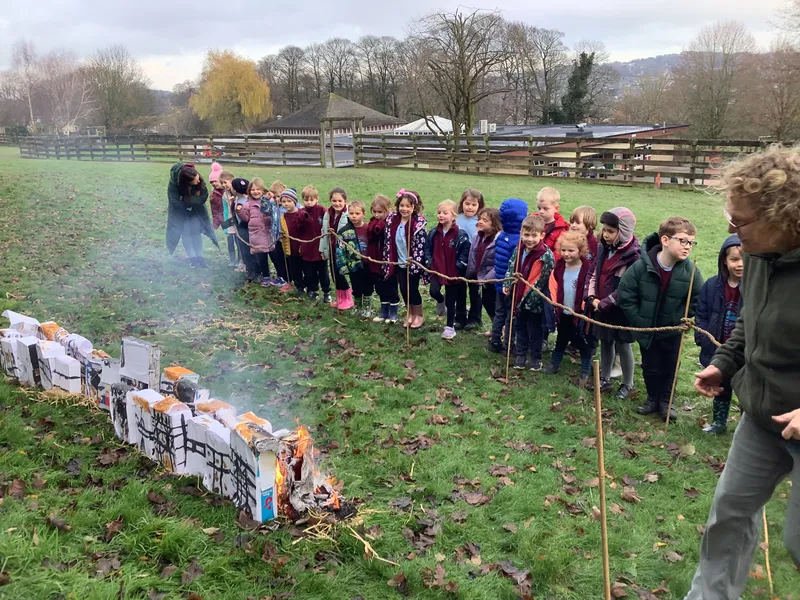
Great Fire of London workshop


